
Beyond Guardrails: Why Enterprise AI Needs a Semantic Control Plane
Overview
Most enterprise AI discussions still start with a familiar idea: fix the data first, then add guardrails around the model. That is necessary, but it is no longer sufficient. As AI agents move from answering questions to reading systems, calling tools, and triggering actions, organisations need a stronger operating model between the agent and the enterprise estate.1 2 3 4 5
The missing layer is not just another prompt wrapper or policy checklist. It is a governed, business-aware layer that understands what the organisation means by terms such as employee, supplier, invoice, approval, cost centre, and urgent; can evaluate the context of an agent request; and can enforce policy before data or actions are exposed.6 7 8 9 10 This article refers to that layer as a semantic control plane: a policy and context layer that sits between AI agents and enterprise systems.8 5 11
For CIOs, this changes the conversation. The challenge is not only that enterprise data is messy. The challenge is that enterprise meaning, process, ownership, and access context are fragmented across systems, teams, and vendors.9 10 11 For technical teams, the implication is equally important: AI guardrails are only one part of the picture, because the main risk is no longer just bad output from a model, but bad access, bad context, and bad actions across enterprise systems.12 13 14
Why guardrails are not enough
Guardrails are useful for catching unsafe prompts, filtering outputs, preventing toxic content, and routing sensitive actions for review.15 16 17 They help at the model boundary, but they are not a complete operating model for enterprise AI.12 15
In practice, enterprise agents fail in more structural ways:
- They retrieve data without understanding business definitions or local process rules.6 18
- They operate across systems whose schemas are technically connected but semantically inconsistent.9 10 11
- They inherit broad service-account access that does not reflect the purpose of the request.19 20 21
- They can act in ways that are syntactically valid but operationally wrong.22 23 24
This is why the phrase “guardrails” can be misleading. It suggests the problem is mostly about constraining model behaviour. In enterprise settings, the deeper problem is that an agent needs governed business meaning, contextual authorisation, and runtime policy enforcement before it should be trusted with real data or actions.1 7 2
The starting insight: data access is not business understanding
Connecting an AI agent to enterprise systems through MCP, APIs, or direct data access does not mean the agent understands how the organisation works.25 26 27 Two organisations can run the same ERP, HR, CRM, or procurement platform and still use very different processes, approval paths, policy interpretations, naming conventions, and exceptions.28 29 30
That gap is often hidden in vendor demos. Demo organisations are tidy, static, and internally consistent. Real organisations are not. They have overlapping applications, local workarounds, partial master data, inherited permissions, siloed ownership, and constant change.31 32 9
This leads to a key conclusion: enterprise AI cannot rely on the model learning the business from raw data alone. It needs an explicit, governed representation of how the business works.33 6 34
Ontology as the missing layer
That representation is increasingly being described as an ontology, semantic layer, or enterprise context layer. Across the current literature, the idea is consistent: large language models know the world in general, but they do not know the organisation’s world unless that meaning is modelled explicitly.35 6 17
An enterprise ontology provides a formal model of:
- business concepts such as employee, customer, supplier, contract, invoice, asset, route, or case;
- relationships such as reports to, belongs to, supplied by, approved by, supports, depends on, or located in;
- business rules such as approval thresholds, eligibility conditions, ownership, policy constraints, and lifecycle states;
- cross-domain meaning, so that the same concept can be used consistently across HR, finance, procurement, operations, and customer systems.31 32 33 34 35
This is why so many enterprise AI teams are now converging on ontology. It is not because ontology is fashionable. It is because AI agents need a governed way to reason about the organisation, and raw schemas are not enough.6 22 35
Why one domain ontology is not enough
At first glance, it is tempting to imagine one ontology for HR, another for procurement, another for finance, and so on. But that is not enough either. Enterprise work crosses domain boundaries constantly: employees submit purchase requests against cost centres, managers approve them under finance policy, suppliers fulfil them, and assets are later assigned to sites or teams.9 11 35
That means the long-term requirement is an enterprise-wide ontology with shared concepts across systems and domains, not just isolated domain models.36 37 38 Shared concepts such as employee, organisation, department, cost centre, location, legal entity, and supplier act as the connective tissue.37 39
This quickly raises a governance challenge. A single enterprise graph may be the right target state, but no business unit wants to own or edit the whole thing. That makes federated ontology governance a more realistic model: domain teams own their parts, while a central governance function manages shared concepts, standards, change control, and cross-domain alignment.38 39 40
A better mental model: the multi-layer PCB
A useful way to visualise the enterprise ontology is as a multi-layer PCB. Each layer represents a business domain such as HR, finance, procurement, operations, or customer service. Shared organisational concepts behave like the vias or through-holes that connect the layers together.
This metaphor matters because it solves two communication problems. First, it explains why the graph must be one connected whole without forcing every stakeholder to view it all at once. Second, it explains how teams can work safely and independently in their own layer while still aligning through governed shared nodes.38 41
In practical terms, a good ontology tool should support domain views, shared-node governance, and cross-layer impact analysis. The underlying model can still be one graph, but the user experience should feel layered, modular, and safe.41 42
A purchasing example
The value becomes clearer in a concrete business flow. Consider purchasing. A traditional data model might show purchase requests, approval records, suppliers, and products. A semantic model goes further: it makes the business logic explicit.6 33
A purchasing layer could include nodes such as:
- PurchaseRequest
- ApprovalRule
- Approval
- Employee
- CostCentre
- Supplier
- Product or Service
The graph could then model relationships such as:
- request submitted by employee;
- request for cost centre;
- request for supplier;
- request matches approval rule;
- approval completed by approver.34 35 37
That means an AI agent does not just see a row saying request 1234 has value £8,000. It can understand that the request is for IT hardware, tied to the IT Operations cost centre, above a threshold requiring two approvals, and still awaiting one approval before it can proceed. That is business understanding, not just data retrieval.22 33
The more promising architecture: a semantic control plane
A stronger pattern is emerging from current control-plane, semantic-layer, and authorisation thinking. The semantic layer does not need to sit in the hot path for all data retrieval. Instead, it can act as the policy and context engine that evaluates what an agent is trying to do, then authorises downstream access in a governed way.1 8 45
In this model, the semantic control plane:
- understands the enterprise ontology and policy model;
- evaluates the identity of the requester and the declared purpose of the request;
- determines what scope is permissible in the current context;
- records the decision for audit and governance;
- and only then enables access to the downstream database, application, or API.7 17 19 20
This is broader than classic AI guardrails. It is closer to a semantic policy layer for the enterprise.1 23 45
Why a separate application matters
This layer should ideally be controlled by the organisation, not hidden inside an AI vendor’s product. A separate application or platform layer gives the enterprise a vendor-neutral point of policy enforcement and reduces the risk that a specific AI vendor can bypass the controls or define meaning on the organisation’s behalf.44 46 47
That is important strategically because most large organisations will not use just one model, one agent framework, or one business application. They will need a consistent control approach across many AI tools and many data/application vendors.47 48 49
At the same time, data and application vendors should still play a role. The control plane can define policy and scope centrally, but downstream systems need native support for context-aware, fine-grained enforcement if the pattern is to work at scale.48 49 50
From federator to token broker
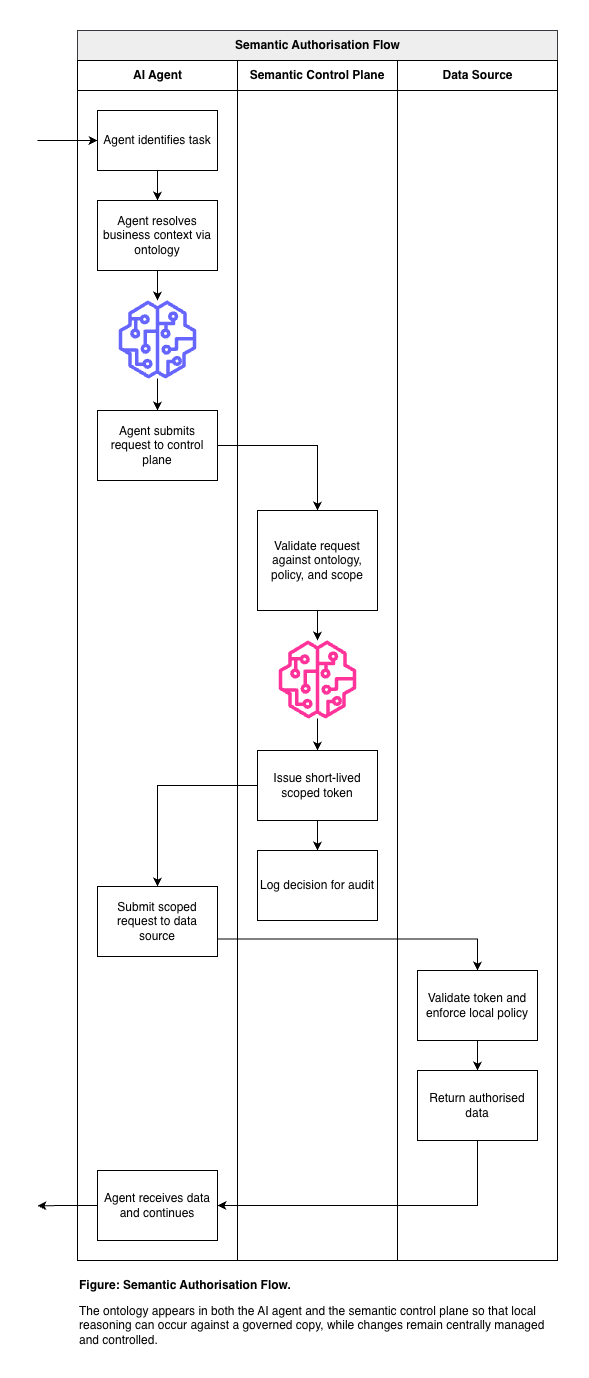
A useful refinement is to avoid making the semantic control plane behave like a universal data federator. Instead, it can act more like a semantic token broker.49 50 51
The pattern would work like this:
- An AI agent makes a request and declares not just identity, but operational context, such as purchasing, sales analysis, payroll audit, or supplier onboarding.19 20 52
- The semantic control plane evaluates that request against the ontology, policies, and current context.20 52 51
- It issues a short-lived token whose claims encode the permitted scope of the request.49 50 58
- The target database or application validates the token and enforces the scope locally.50 51
- The token expires quickly, so each significant request requires fresh evaluation.49 50
This changes the role of the control plane. It does not need to read all the data itself. It needs to decide what the agent is allowed to ask for, in what context, for how long, and under what constraints.45 51
Why context needs to be in the token
This is one of the most important implications for CIOs and architects. Today, many agents effectively use broad service accounts or inherited user access. That is not a safe long-term model because the target system only knows that a caller is authenticated, not what purpose the current request serves.19 21 46
A better design is to treat authorisation as context-bound. The token should not just assert identity. It should also assert business scope: for example, that the request is for purchasing analysis in a specific domain, with permission to access certain data classes and no permission to cross into unrelated HR or payroll data.20 51 58
This aligns with broader work in context-aware access control, purpose-based access control, and knowledge-based access control. The underlying principle is consistent: access decisions should reflect not just who is asking, but why, in what context, and against which governed business concepts.18 20 53
What was considered and then discounted
Several initial ideas seem attractive but become weaker under scrutiny.
1. “Fix the data first” as the main prerequisite
This is still important, but it is not enough. Master data quality and governance are already difficult in most enterprises, and AI adds a new requirement: the organisation must also model what the data means and how work is done. A perfectly cleaned data estate without a semantic operating model still leaves agents blind to business context.9 10 43 6
2. Relying on vendor-native agents alone
Vendor agents are often designed around demo organisations or platform-native abstractions. Those can be useful, but they are unlikely to reflect the organisation’s real local processes, exceptions, and cross-system semantics. The more systems an enterprise uses, the weaker a single-vendor worldview becomes.28 31 11
3. Treating guardrails as the complete answer
Guardrails remain necessary, but they are a partial control. They do not by themselves provide enterprise meaning, ownership, policy lineage, or context-aware authorisation.12 15 6
4. Building one giant flat graph for everyone
That target state is too unwieldy for day-to-day business collaboration. A layered, federated model is more realistic because it allows domain ownership while preserving one connected enterprise graph.38 39 40
5. Using the semantic layer as a full data federator
This is the biggest design idea that should be treated carefully. A semantic control plane that proxies every query and acts as a universal federated data engine could become a bottleneck and a performance concern.44 45 46 For many enterprise workloads, that is likely the wrong design centre.
What CIOs need to think about
For CIOs, the message is not “fix the data and wait”. It is that agentic AI changes the enterprise control problem in four ways.
1. Meaning becomes infrastructure
The organisation needs a shared semantic model of key concepts, relationships, and rules, not just cleaner records and better APIs.6 17 11
2. Governance must move up the stack
Master data governance remains important, but it needs to be extended into federated ontology governance, where business owners are accountable for definitions, relationships, and rules in their domains.43 38 39
3. Authorisation must become context-aware
Static role-based access and service accounts are too blunt for autonomous agents acting across many tools and data stores. Enterprises need purpose-aware, short-lived, policy-driven access patterns.18 20 51
4. Vendor strategy matters
If semantic control is embedded only inside individual AI products, the enterprise will lose consistency. A vendor-neutral control plane is more likely to survive changes in models, agent frameworks, and application vendors.44 47 45
What technical teams need to think about
For enterprise architects, data leaders, and platform teams, the practical questions become more specific:
- Which shared business concepts must be modelled first to unlock real use cases?56 38
- Which domains can own their layers of the ontology, and who governs shared nodes?38 39 40
- Where should policy be decided centrally, and where should it be enforced locally?45 50 51
- How will context be expressed in requests, tokens, and downstream enforcement?49 50 51
- Which tools can support layered business views over one connected semantic model?54 42 55
These are not only data questions. They are operating-model questions.
Has this been invented before?
The answer is partly yes and partly no. The ingredients already exist in adjacent forms: ontology-based context-aware access control, semantic layers, AI control planes, and short-lived scoped tokens are all established ideas.53 57 50 51 What is still emerging is the coherent synthesis of those ideas into a vendor-neutral enterprise pattern for AI agents.1 8 45
That matters because originality in enterprise architecture often comes less from inventing a brand-new primitive and more from combining existing primitives into a sharper design that addresses the next operational problem. In this case, the emerging problem is clear: AI agents need more than guardrails. They need governed meaning, contextual authorisation, and a trustworthy policy layer between models and enterprise systems.1 45 12
A working thesis
A useful thesis for enterprise leaders is this:
Models should not talk to enterprise data directly. They should operate through a semantic control plane that understands business context, evaluates purpose, and authorises bounded access to downstream systems.1 45 51
That thesis does not replace data quality, master data, or guardrails. It builds on them. But it suggests that the next step in enterprise AI architecture is not merely better prompting or more connectors. It is a new control layer that can translate between business meaning, enterprise policy, and machine action.1 7 45
Conclusion
The enterprise AI debate is starting in the wrong place when it reduces readiness to “clean the data” or “add guardrails”. Those are important steps, but they do not solve the deeper question of how an organisation exposes its business reality to autonomous systems safely and consistently.1 3 12
The more complete answer is likely to include an enterprise ontology, federated governance, layered domain modelling, and a semantic control plane that evaluates context and issues bounded access. The organisations that work this out first will be in a much stronger position to deploy agents across real business processes without giving up control to whichever AI vendor happens to be in fashion this year.6 38 45
NOTE: The ideas in this article are my own, developed through original reasoning and discussion. AI was used to help refine the draft and identify relevant references to other people’s work.
References
[1] Atlan. Do Enterprises Need a Context Layer Between Data and AI? https://atlan.com/know/context-layer-enterprise-ai/
[2] Atlan. AI Control Plane: Components, Architecture and Use Cases. https://atlan.com/know/ai-control-plane/
[3] Colrows. What Is a Semantic Layer? A Guide for Enterprise AI. https://colrows.com/what-is-a-semantic-layer/
[4] ACM. Vendor-Neutral, Multitenant Enterprise Retrieval and Tool Use. https://dl.acm.org/doi/10.1145/3786335.3813145
[5] TrueFoundry. What Is an AI Control Plane? https://www.truefoundry.com/blog/what-is-ai-control-plane
[6] EY. Ontologies as the missing layer in enterprise AI. https://www.ey.com/en_us/insights/consumer-products/ontologies-as-the-missing-layer-in-enterprise-ai
[7] Atlan. Context Layer for AI Agents: Enterprise Guide 2026. https://atlan.com/know/context-layer-for-ai-agents/
[8] Fiddler. The Control Plane for AI Agents. https://www.fiddler.ai/control-plane
[9] EMIXA. SAP Master Data Governance: Turning Data into a Strategic Asset. https://www.emixa.com/blog/sap-master-data-governance-turning-data-into-a-strategic-asset
[10] insightsoftware. Master Data Governance. https://insightsoftware.com/encyclopedia/master-data-governance/
[11] OMG. Enterprise Knowledge Graph Platform Task Force. https://www.omg.org/ekg/
[12] IAPP. AI guardrails are not enough and governance teams should understand why. https://iapp.org/news/a/ai-guardrails-are-not-enough-and-governance-teams-should-understand-why/
[13] LinkedIn. The Missing Layer in the AI Stack. https://www.linkedin.com/posts/gopisetty_the-missing-layer-in-the-ai-stack-why-agents-activity-7434733458712641536-uEjZ
[14] OpenAI. Guardrails and human review. https://developers.openai.com/api/docs/guides/agents/guardrails-approvals
[15] OpenAI Cookbook. How to implement LLM guardrails. https://cookbook.openai.com/examples/how_to_use_guardrails
[16] Kalvium Labs. LLM Guardrails That Actually Work in Production. https://www.kalviumlabs.ai/blog/guardrails-for-llm-applications/
[17] ServiceNow. Context Engine. https://www.servicenow.com/products/context-engine.html
[18] Immuta. What Is Purpose-Based Access Control (PBAC)? https://www.immuta.com/blog/purpose-based-access-control/
[19] KuppingerCole. Agentic AI and Data Access Control as the New Security Perimeter. https://www.kuppingercole.com/blog/balaganski/agentic-ai-and-data-access-control
[20] Oso. AI Agents and Context-Aware Permissions. https://www.osohq.com/learn/context-aware-permissions-for-ai-agents
[21] LinkedIn. Ontology Is the Control Plane. [https://www.linkedin.com/pulse/ontology-control-plane-why-enterprise-ai-fail-without-gaurav-agarwaal-xxgzc](https://www.linkedin.com/pulse/ ontology-control-plane-why-enterprise-ai-fail-without-gaurav-agarwaal-xxgzc)
[22] Novalogiq. Ontology is the real guardrail. [https://novalogiq.com/2025/12/01/ontology-is-the-real-guardrail-how-to-stop-ai-agents-from-misunderstanding-your-business/](https://novalogiq.com/2025/12/01/ ontology-is-the-real-guardrail-how-to-stop-ai-agents-from-misunderstanding-your-business/)
[23] LinkedIn. The Semantic Layer Is Necessary. It Is Not Sufficient. https://www.linkedin.com/pulse/semantic-layer-necessary-sufficient-navdeep-singh-gill-ka7xc
[24] Anthropic. Introducing the Model Context Protocol. https://www.anthropic.com/news/model-context-protocol
[25] Ciphix. From API to Enterprise MCP: AI needs context & governance. https://ciphix.io/en/from-api-to-enterprise-mcp-why-ai-automation-needs-context/
[26] Striim. Real-Time Context: Unlocking MCP & Agentic AI for Enterprises. https://www.striim.com/blog/the-power-of-mcp-how-real-time-context-unlocks-agentic-ai-for-the-modern-enterprise/
[27] Bizzdesign. Model Context Protocol (MCP): Turning Enterprise Architecture Into AI-Ready Intelligence. https://bizzdesign.com/blog/model-context-protocol-mcp-turning-enterprise-architecture-ai-ready-intelligence
[28] Atomicwork. Enterprise knowledge graphs: Why in the age of AI agents, context is everything. https://www.atomicwork.com/blog/why-enterprise-knowledge-graphs
[29] Decube. The Future of Data Context in Enterprise AI. https://www.decube.io/post/data-context-enterprise-ai
[30] Firemind. The model context protocol: a new standard for enterprise AI integration. https://firemind.com/insights/the-model-context-protocol-a-new-standard-for-enterprise-ai-integration/
[31] Atlan. Ontology in AI: Components, Standards & Agent Applications. https://atlan.com/know/what-is-ontology-in-ai/
[32] TopQuadrant. How Ontologies Are Paving the Way for Enterprise AI. https://www.topquadrant.com/resources/from-hype-to-reality-how-ontologies-are-paving-the-way-for-enterprise-ai/
[33] Infinite Lambda. Business ontology that your agents reason on. https://infinitelambda.com/business-ontology/
[34] Zero100. Knowledge Graphs: An Underutilized (and Safe) Agentic AI Unlock. https://zero100.com/insights/knowledge-graphs-an-underutilized-and-safe-agentic-ai-unlock/
[35] Siemens. Enterprise Knowledge Graphs. https://www.siemens.com/en-us/solutions/data-analytics-artificial-intelligence/knowledge-graphs/
[36] LinkedIn. Enterprise Knowledge Graphs: A Strategic Framework for Unified Enterprise Context. https://www.linkedin.com/pulse/enterprise-knowledge-graphs-strategic-framework-2025-shardorn-tspde
[37] LEADing Practice. Enterprise Ontology. https://www.leadingpractice.com/enterprise-standards/enterprise-engineering/enterprise-ontology/
[38] Semantics Conference. A Framework for Federated Ontology Contribution and Governance. https://2022-eu.semantics.cc/framework-federated-ontology-contribution-and-governance
[39] Mesh-AI. What Every Business Leader Needs to Know About Federated Data Governance. https://www.mesh-ai.com/blog-posts/what-business-leaders-need-to-know-federated-data-governance
[40] OvalEdge. Federated Data Governance Explained. https://www.ovaledge.com/blog/federated-data-governance
[41] metaphacts. A guide to ontology governance in metaphactory. https://blog.metaphacts.com/a-guide-to-ontology-governance-in-metaphactory
[42] metaphacts. metaphactory 4.0 Introduces Visual Ontology Modeling. https://metaphacts.com/metaphactory-4-0
[43] SAP. Master Data Governance. https://www.sap.com/products/data-cloud/master-data-governance.html
[44] Denodo. Agentic AI. https://www.denodo.com/en/solutions/by-technology/agentic-ai
[45] Strategy. Semantic Layer Architecture: Why Platform-Agnostic Beats Platform-Native for Enterprise AI. https://www.strategy.com/software/blog/semantic-layer-architecture-why-platform-agnostic-beats-platform-native-for-enterprise-ai
[46] K2view. What are data agents? The bridge between agentic AI and enterprise data. https://www.k2view.com/what-are-data-agents/
[47] Oracle. Build AI That Works for Business. https://www.oracle.com/a/ocom/docs/build-ai-for-business.pdf
[48] AtScale. Best Data Governance Tools for Enterprise: 2026 Guide. https://www.atscale.com/blog/best-data-governance-tools/
[49] Raidiam. API Security and AI Agents. https://www.raidiam.com/insights/api-security-ai-agents-safeguarding-sensitive-enterprise-data
[50] Microsoft. Access tokens in the Microsoft identity platform. https://learn.microsoft.com/en-us/entra/identity-platform/access-tokens
[51] Okta. Securing AI Agents From Development to Enterprise Scale. https://www.okta.com/sites/default/files/2026-04/securing-ai-agents-from-development-to-enterprise-scale.pdf
[52] DataHub. Context-Aware AI Agents: Why Most Aren’t. https://datahub.com/blog/context-aware-ai-agents/
[53] Oxford Academic. An Ontology-Based Approach to Context-Aware Access Control for Software Services. https://academic.oup.com/comjnl/article/58/11/3000/448982
[54] The Open Group. The ArchiMate Enterprise Architecture Modeling Language. https://www.opengroup.org/archimate-forum/archimate-overview
[55] Stardog. Stardog Studio. https://www.stardog.com/studio/
[56] LinkedIn. How to build an Ontology for your business. https://www.linkedin.com/posts/chad-wahlquist_dont-build-the-field-of-dreamsno-one-activity-7396587745202204673-H6dY
[57] Strategy. Semantic Layer vs. AI Control Plane: Why Enterprise AI Needs Governed Context. https://www.strategy.com/software/blog/semantic-layer-vs-ai-control-plane-why-enterprise-ai-needs-governed-context
[58] SuperTokens. Authentication for AI Agents. https://supertokens.com/blog/auth-for-ai-agents