
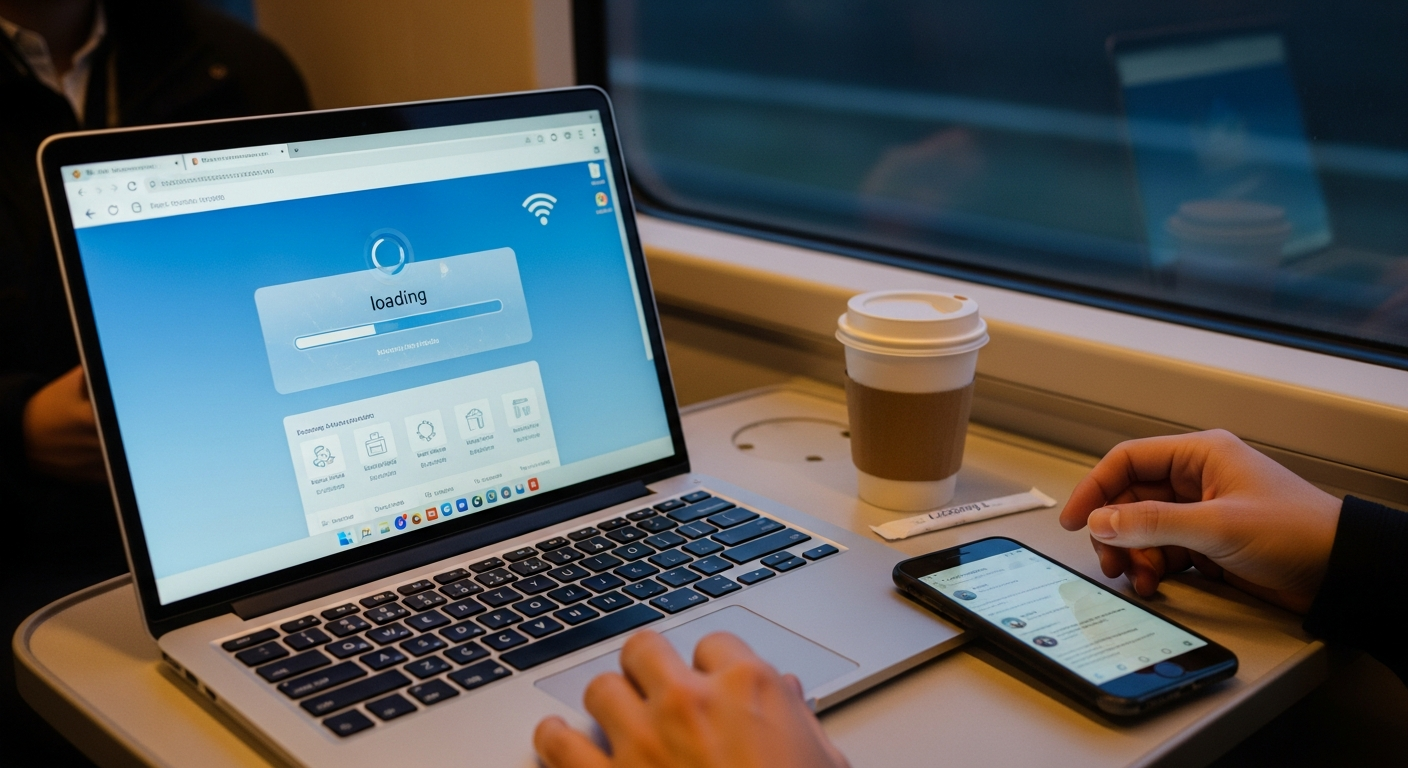
Did cloud kill the mobile worker?
Getting the work-life balance correct has always been a challenge, with mobility allowing us to slowly blur those differences as we travel. But is the end of the line in sight?
I’ve always considered myself fortunate to be able to take my work on the road. Armed with a laptop, a few essential apps, and a decent mobile hotspot, I get to travel around the UK freely. But lately, I’ve noticed something that feels ironic—perhaps even backwards. Despite the power of cloud technologies, being a truly mobile worker is getting harder.
Connectivity
Remember when you had to pay for Wi‑Fi on trains, in bars, and in hotels? The “premium” connection gave you just enough bandwidth to sync email or run local reports before analysing the results offline. Back then, software respected the limits of mobility.
Now we live in the age of smartphones—miniature supercomputers promising lightning-fast 5G wherever we go. And yet, we still can’t reliably stream a radio station while hurtling through the countryside. How the younger generation manages to keep up with social feeds on the move amazes me.
Content
Once upon a time, web apps were designed with the mobile worker in mind. Bandwidth mattered. Data payloads were lean. Even the BBC has a “low data mode” for emergencies, delivering just the essentials: context, clarity, and speed. Contrast that with today’s bloated web experiences—videos before headlines, analytics dashboards that refuse to load without a full connection.
Applications
The cloud transformed how organisations run their servers and release software. Client installations became rare, replaced by browser-based everything. It’s efficient for IT teams but not always for the worker on the move. Web-first applications often assume a stable high-speed link—something the mobile worker can’t always count on.
Increasingly, when researching a new application, I pay attention to its offline capabilities to see if it suits my mobile office. For example, I use Notion and AmpleNote Desktop for notes and personal knowledge management—both let me update content seamlessly while on the move, syncing later when the signal allows.
Artificial Intelligence
And then came AI—the hottest thing in tech, sold to executives as the next great efficiency revolution. The problem? It lives entirely in the cloud. On a recent train journey, I decided to tidy a small app and test out Google’s latest Gemini/Infinity features. It should’ve been quick.
It wasn’t. Each request hung until it failed, demanding the kind of “stable connection” that railway blackspots refuse to provide. Between retrying my AI queries and restarting a stalled music stream, productivity melted away. Down the carriage, another traveller tapped out a few emails—simple, local, and likely to send later when the signal allowed. Who was really working smarter?
The cloud liberated us from servers but tied us back to the signal. For those of us who built entire careers around mobility, that dependency raises a question: